It Worked!
Last time, I talked about how I do my best thinking when I quit thinking. Last weekend, my husband Homer and I were at dinner with our friends Dennis and Jane. Dennis follows my blog. As we were walking into the restaurant he said, “Hey, I liked that last blog – the one about stopping thinking to think better.”
Fast forward to dinner. Homer and Dennis are in a band together (Homer and the Plainsmen). Jane and I are groupies (NOT roadies – there are limits). So they are likely at any given point to be discussing music. At one point during dinner, Dennis was trying to recall the name of a song and who originally did the song. He couldn’t grasp the name no matter how hard he tried. I looked at him and inquired, “What is your favorite Mexican food restaurant?” (that’s the advice I gave in that blog about helping a friend when they get stuck – take their mind elsewhere and watch the answer they are grasping for appear).
Dennis knew what I was doing because he had read the blog. He looked at me and laughed, then went there. I don’t know if he actually told me the name of the restaurant, but he did let go of the quest for THE NAME.
Not one minute later he said, “My Maria by B.W. Stevenson!” We had high fives all around.
It works. Give it a try – stop thinking to do your best thinking.
Courage is a Habit
Recently, I talked about the notion that we never regret brave.
Over the Thanksgiving weekend, I was catching up with my twin’s wife, Jenny. It’s always fun to catch up with Jenny; she’s an immigration attorney and struck out on her own a few years ago to start her own practice. Jenny believes in what she does and that she is helping people who need help, who need representation and are under-represented. She was telling me about the challenges of building and developing her practice — about facing her biggest challenges. Somewhere in the conversation I said, “Courage is a habit.”
Funny thing is, as I said it – “courage is a habit” – I realized that is something I believe, just had not put into words before.
Habit is defined as an acquired behavior pattern regularly followed until it has become almost involuntary; courage is the quality of mind or spirit that enables a person to face difficulty, danger, pain, etc., without fear (bravery).
Once we do the brave thing once, another thing that requires us to be brave pops up right away. We never regret being brave; in fact, it helps build a courageous quality of mind. It can become a habit; a way of life. Making the decision, making the choice, taking the action that is often the one that makes us a bit queasy, a bit shaky, definitely uncomfortable. That’s ok; it is through conflict, through friction, that progress is made.
So, for me, I just have to wake up each day and practice brave; practice courage. What is the conversation I am dreading having because it could be uncomfortable? Schedule it. What is the message I am nervous delivering because I’m likely to make someone uncomfortable? Deliver it. Where do I need to request help? Reach out.
There’s a belief in the Buddhist tradition that the avoidance of suffering causes more suffering than the actual suffering. When we aren’t being courageous, aren’t we just trying to avoid suffering? Are we trying to avoid rejection, feeling uncomfortable, or even the suffering of failing? But life is not about being comfortable, it’s not even about seeking pleasure. I believe it’s about pursuing our particular potential; our particular and unique genius (which we all have.) That kind of pursuit requires bravery, demands courage. Yours looks different from mine.
Some days I suck at this. Some days I try, some days I fail. I practice.
Every day, I see Wisegate members practicing bravery. Kris Knight, senior privacy officer at Phillips Electronics and an early Wisegate founding member, approaches the topic of privacy by embracing complete transparency (Kris calls herself the least private privacy person she knows). Her point of view, which she champions, is that often the aggregation of data (meaning it’s not kept private) is how companies can serve their customers better. Health care companies, for instance, can benefit patients with evidence-based medicine.
Kris champions this approach because she believes in it. That’s quite a brave view in her arena, and it’s inspiring to see her practice courage. Kris (and others) are also brave as they join us in our vision of being the best knowledge resource in the world for senior technologists. They are brave as they introduce peers to Wisegate – brave because we are new and we are creating something new in the world. And, that takes courage. I’d like to thank them for their courage on our behalf.
I Do My Best Thinking When I Quit Thinking
I’m running an experiment on thinking.
Have you ever noticed that when you are in the middle of a sentence and you lose your train of thought that the harder you try to get the thought back, the more elusive it is? Or when you are trying to think of someone’s name and you can even see their face, but you can’t get the name to come to mind no matter how hard you try?
I have found that when I can’t brute-force my way into remembering what I am trying to remember, if I can just let go and move on to something else, the thought or the person’s name magically appears almost without fail.
The next time you are with someone and they lose their train of thought, try this: quickly and gently ask them a question on a completely unrelated topic. For instance, if they are trying to recount the name of something, ask them what their favorite Mexican food restaurant is. Or, if they are trying to remember the name of their boss three bosses ago, ask them who they like for the Superbowl this year. Almost invariably, within a short few moments, the thought they could not grab hold of will come to them.
This is probably old news for many of you. Me, not so much. I still find this fascinating.
So I am trying an experiment to take this to a new level. Last week, this topic came up when I was talking with John Long, who runs Trellis Partners and is a Wisegate board member, investor and friend. We were heading into the holiday weekend and discussing how nice it will be to take some much-needed time off. John brought up the subject of taking problem solving from the conscious brain to the unconscious brain (count on John for such erudite thoughts; me? I think – I do my best thinking when I just quit thinking…). John suggested I try going into the holiday weekend by framing a question that is challenging me – just frame it up – then let it go and see what happens.
I did just that. One of my to-do’s for Wednesday before Thanksgiving was to “frame up a question.” That’s it. So that’s what I did. Then I let go and went into the feast weekend. Sure enough, I had insight come to me by Sunday. Super practical and completely actionable? No, not yet. But real insight is a treasure. So, I am going to make a practice of this for a while and see if I can develop this into a skill. I figure I need all the help I can get.
And I realize that this skill is an internal version of Wisegate: asking trusted peers what they think about a sticky problem then letting it go. Letting other brains help with the hardest problem plaguing you. The internal version is to stop thinking to do your best thinking; trust your unconscious brain to help you. Give it a try. I’d love to hear how it works for you.
A Poem
Thanksgiving week is here, and the beginning of the holiday season. I am filled with gratitude for many things, and also very hopeful for the year ahead.
I’ve been thinking a lot lately about how progress – both professional and personal – can begin with communicating with authenticity and listening well. Today, I have a more personal blog entry. I’d like to share a poem I wrote last weekend. And I wish for you a wonderful holiday.
If tears are words to be spoken
I must have a lot to say
I fear I would repeat myself
I can’t speak for the pain
If tears are words to be spoken
Each one deserves its place
In oratory declaration
Somewhere in time and space
My tears are words to be spoken
They are nothing to dread
They inform and instruct and even delight
And remind me I’m not dead
Your tears are words to be spoken
What do you have to say?
You are worth expressing
Though it’s hard to speak through the pain
Each tear is a word that needs speaking
That is how our wounds heal
Whether listening, speaking or crying
Living requires this zeal
The world has tears that need speaking
From hate, religion and fear
Speaking is how we heal the world’s wounds
And listening with respect and care
Imagine a world
With no more tears that need speaking
Where would we be then?
The heaven of our dreams
Instead of the hell we’re in.
P.S. I ran over my laptop.
I ran over my laptop this week. Ran right over it with my car. I guess it could have been worse. I had 2 laptops, my Mac Air and my MacBook Pro in my bag. The Air wasn’t even touched. I’m using it right now to type this post.
Here’s what the Pro looks like now.
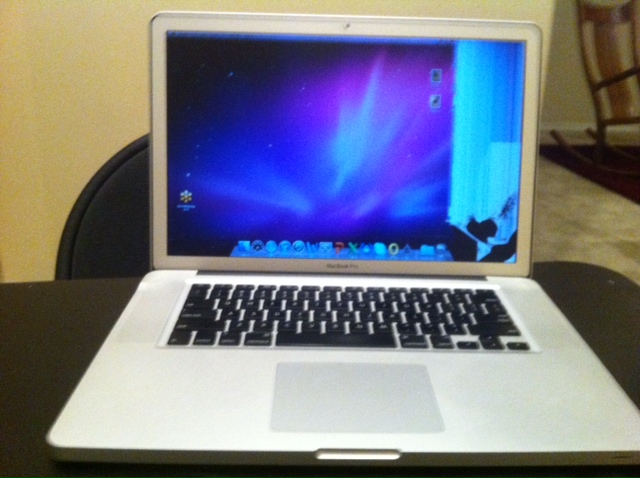
That white stripe down the right edge? Tire tread.
Did you see my last post where I was talking about busy not being equal to important? Wasn’t I just making the point that we can slow down and in fact should slow down?
Blogger, heal thyself.
I was headed out to my car after work and I had too much in my hands (metaphor, anyone?) . I set down my computer bag so that it was leaning against my rear driver-side wheel while I loaded the other stuff (like my favorite Prada handbag, a picture, my workout bag, my food bag; you know — workday detritus).
Well, the next thing I remember is feeling this thump-thump — like going over a small speed bump or a cat (sorry, cat lovers; just trying to illustrate what it felt like). But I pull out of this parking spot all the time and I couldn’t recall there being a speed bump in that location. Heart sinks. Mind thinks: what did I just do?
My mind was so busy because I am so important (ha!), that I left my computer bag leaning against my tire. And then I ran over it. Crunch. Bye-bye, Pro.
What was I thinking about in those moments that was so vital that I would forget about the most important item I was juggling (well, maybe a tie with the Prada)? I have no idea. It was just a dramatic version of misplacing your keys, or jumping into a pool with your smart phone in your pocket. Once the shock of what just happened began to fade, I saw the humor.
And I saw it as the universe tapping me on the shoulder.
Have you felt that tap-tap recently? Did it cause you to step back and look at a situation differently, and perhaps be open to different approaches? And when you want to see things from a different angle, do you have peers who can help?
Busy ≠ Important
Is it just me or does everyone seem crazy busy all the time?
I was on a business trip this week and noticed as I was in airports and airplanes and taxis and meetings that most people were taking calls, making calls, checking email and texting non-stop. It’s not just on trips – I see it in the office, I see it in the car, I see it everywhere.
I can’t help but wonder whether at this moment in our society we equate busy with important. The more I have to do, the more I have to check in to make sure things are going ok, the more I’m on my phone, the more I have to email — well then, the more important I am. Do we believe that busy = important?
I am describing myself as much as I am describing my observations of others, though I wish this were not the case. Alas, I am a member of our society, I am alive in the world at this moment and I struggle with this, too.
I do not believe that busy = important. We don’t get our importance from what we do; we bring our importance to what we do. I believe human = important. We show up and we’re important. That’s it.
I try mono-tasking (check out this great book). I try not being on email 24 hours a day. I do this so I can have time to think, to gain insight, to listen. It works – only then do I have the creative spurts to write this blog, for example. And yet I too feel the pull of always being online, on the phone, etc.
I would argue that busy is not equal to important. For us to reach our potential, we need time where we are not too busy to let creativity and insight happen. They need room, and we need to provide it. One of our founding members is Bill Burns, who works for Netflix. He recently told me that he jealously guards his free time – which I found both discerning and inspiring.
One thing we aim to do with Wisegate is save our members time. They tell us they spend inordinate amounts of time scrambling to find information, to find out what their peers at other companies are doing, to stay abreast. Well, that’s why we’re here. I hope we save someone time today that they then use to be not so busy.
Light Bulb or Salad Spinner?
Which would you rather be — the light bulb or the salad spinner? Or, better asked, who would you rather be, the inventor of the light bulb or the inventor of the salad spinner?
Me? Light bulb.
That seems an obvious question, yet I have to argue there are an awful lot of salad spinner ideas out there.
Let’s take the light bulb for a minute. Now that changed lives. I’m sitting here, it’s 6 a.m. and dark. Light bulbs are helping me at this very minute. Light bulbs help me all the time. When they go out, I have a problem.
Now, let’s take the salad spinner. I will admit to having bought one. And, I used it a few times. And, once I washed the greens, put them in the device and did the spinning, there was less water on the leaves. But they were still wet. Really wet. It did not positively impact my life. Basically, it took up a bunch of cabinet space and didn’t help me.
With Wisegate, I am aiming to be a light bulb — to really help people in their jobs by giving them the collective wisdom of their peers. It’s a high aim. I would rather aim for light bulb any day than settle for salad spinner.
How about you?
Easy is Over-rated
There’s nothing wrong with easy. And ease is an end unto itself. I love those moments, those days that flow effortlessly. I love those days that when I am challenged with something difficult (which is most days) and I am able to go through it with ease.
But I have a problem with easy. Is it just me, or do you sense that in our culture at this moment in history we are overly concerned with easy? Take it easy. Do the expected. Take the shortcut. Make it easy on yourself. To me these seem the mantras of today. Yet choosing these will never lead us to our potential. And aren’t we here to reach our potential, whatever that may be?
I’m a word nerd. I love looking up words in the dictionary — even words I know —to get subtleties of which I am not aware. So I looked up “easy.”
Easy — Adj. not hard or difficult; requiring no great labor or effort;a book that is easy to read; an easy victory. Free from pain, discomfort,worry, or care: He led an easy life.
Easy choices will not lead us to achieve our potential on this planet.
Joseph Campbell is one of my favorite authors and he has a lot to say on this subject from his many decades of studying, teaching and writing on comparative religion and myth:
- “It is by going down into the abyss that we recover the treasures of life. The very cave you are afraid to enter turns out to be the source of what you are looking for.”
- “A bit of advice given to a young Native American at the time of his initiation: As you go the way of life, you will see a great chasm. Jump. It is not as wide as you think.”
- “What we are really living for is the experience of life, both the pain and the pleasure.”
- “Opportunities to find deeper powers within ourselves come when life seems most challenging.”
Our members do not have easy jobs. They are tasked with big challenges every day. We asked the members recently how they spend most of their time at work:

I was struck by one comment in particular by our founding member Denny Dean, who is a CISO.
Denny wrote: “Great question! I am looking at a list right now of all the, what I call, “pop-up” projects and “side-bar” initiatives. I coined these terms to communicate what has become a significant component of my work (work generating results that I want my business sponsors to understand and appreciate). These are not wasted efforts, mind you. On the contrary, they are what one might consider “just-in-time solutions” or “serendipity enhancements”. Pop ups are mini projects (hours/days). Side-bar initiatives are micro projects (minutes/hours). All of them have two things in common:
- They are important to improving service or reducing costs, and
- The timing is right to get change implemented because someone is standing at my door and motivated to get something done.
“These evolutionary win-win scenarios help build great cross-functional cooperation models and great peer relations. Embrace them, communicate the successes, and see your successes in the company grow.”
Leadership is not easy. Denny embodies that embracing the hard stuff, the unexpected stuff that comes our way, is part of the same glorious life where the easy stuff is. And there lies the opportunity to make a difference.
I am inspired by our members. Today, I’m inspired by Denny.
Hackers: 21st Century Cattle Rustlers
I was talking to my husband Homer yesterday and telling him about this cool poll on Wisegate:

Homer told me that what’s going on with hackers today is a lot like what the ranchers of the 19th and 20th centuries faced with cattle rustlers. (He grew up on a cattle ranch here in Texas and has a deep understanding of that history and culture.)
As the west got settled and cattle ranching flourished, rustlers showed up, banded together and stole cattle. It was a serious problem. In order for any of the ranchers to survive they had to band together – even though some of them were competitors. They realized that no one rancher had enough manpower to deal with roving bands of rustlers; they needed to create a force that was greater than that of their enemy. They couldn’t go it alone.
It worked. The ranchers put a serious dent in the rustling. They even retrieved a lot of stolen cattle. And when the rustlers saw that stealing cattle was no longer easy, they started looking elsewhere to cause trouble.
Fast forward to today. Hackers are banding together, learning from each other, and devising new ways to cut through security systems (modern versions of barbed wire) to wreak havoc. But the ranchers and cowboys of information security now have Wisegate — a place where they can come together, bring their collective brainpower and create a force to solve this problem.
The connections and conversations that happen on Wisegate every day help our members understand on a very practical level the best ways to protect their companies from attack. Just like in the old days, there’s power in numbers.
We Never Regret Brave
I’ve been called a bumper sticker factory – meaning I can say things in five words or less. A handy little talent. The title here – we never regret brave – is one of my bumper stickers and more importantly, something I believe.
We never regret brave means that in those moments in life when we are faced with a choice, a decision, we never regret taking the path that requires courage. This makes for an interesting life, though not necessarily an easy or comfortable one.
Easy is overrated (another bumper sticker). All of the focus on ease in our culture makes me sad (e.g., “How soon can I earn a bunch of money so I can retire and take it easy” comes to mind). Creating new things, charting new paths, taming new frontiers is not easy or comfortable work. Yet it is how things get created and how things change in our world.
What is the thing you are resisting? Go there.
When I am at one of these decision points, which is often, I invoke my Regret Prevention Filter. In my mind, I become 80-year-old Sara and play out my choices. I play out the safe, secure, well-known path (which is often seductive and easy to rationalize). And I play out the other path — the one that will take courage. Then I look back on this moment, this choice, and I see which direction I will not regret. It is not an easy process, but I can almost always see the decision that will have me sitting there at 80 years old, looking back on a life well-lived.
Wisegate’s founding members are charting a brave path. We are creating something together that will make the world a better place.
Last week, I was sitting with one of our early founding members, Denny Dean, who is a CISO of a major insurance company, and he said to me, “I was a skeptic (about Wisegate); now I am a believer. In a few years, we can be the Facebook for professionals.”
Denny’s right. We are innovating and doing something that makes people’s lives better by making their job better. Recently, one of our newest members, Linda Morrissey of Cigna, sent us an email telling us how much help she had gotten in her first two weeks as a Wisegate member because she was able tap into the wisdom and experience of her peers that have been down the road she is now on.
My sincere thanks to all of our early members. You will never regret brave.

 listening to it